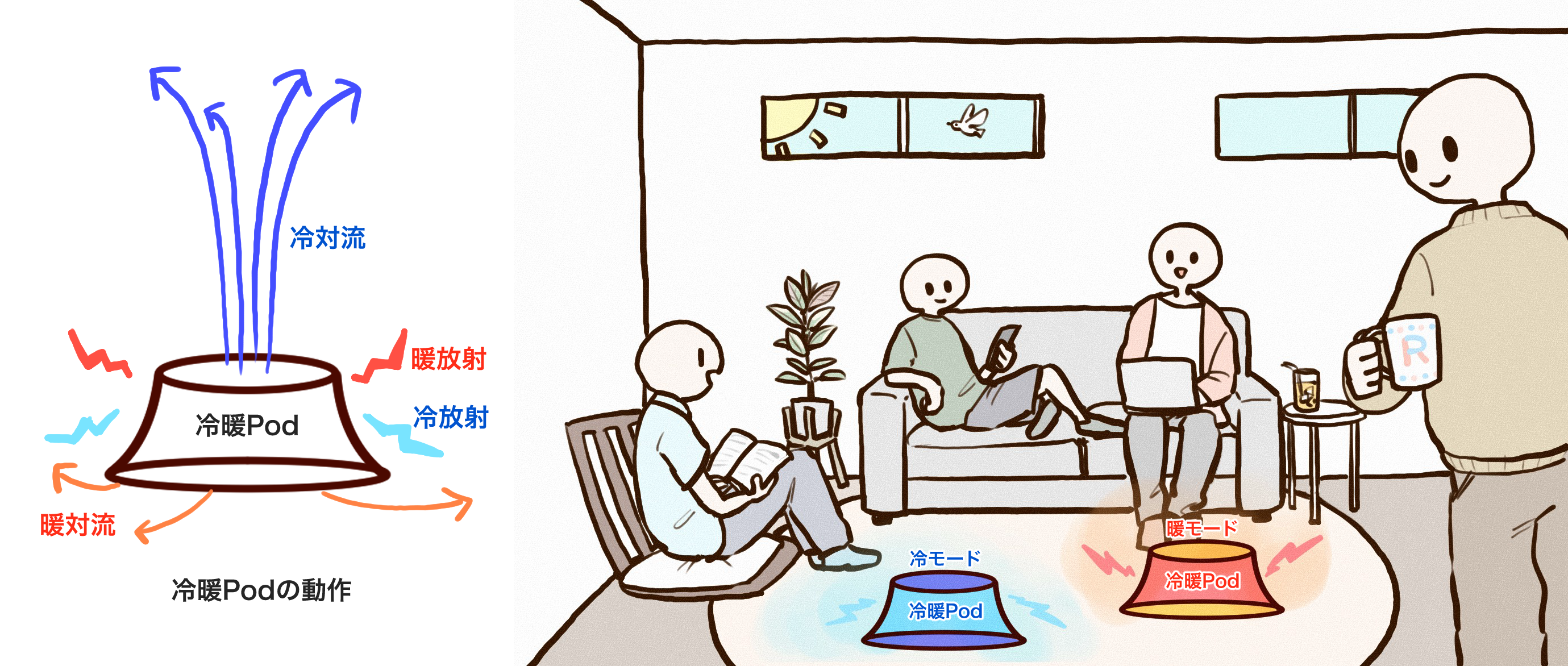
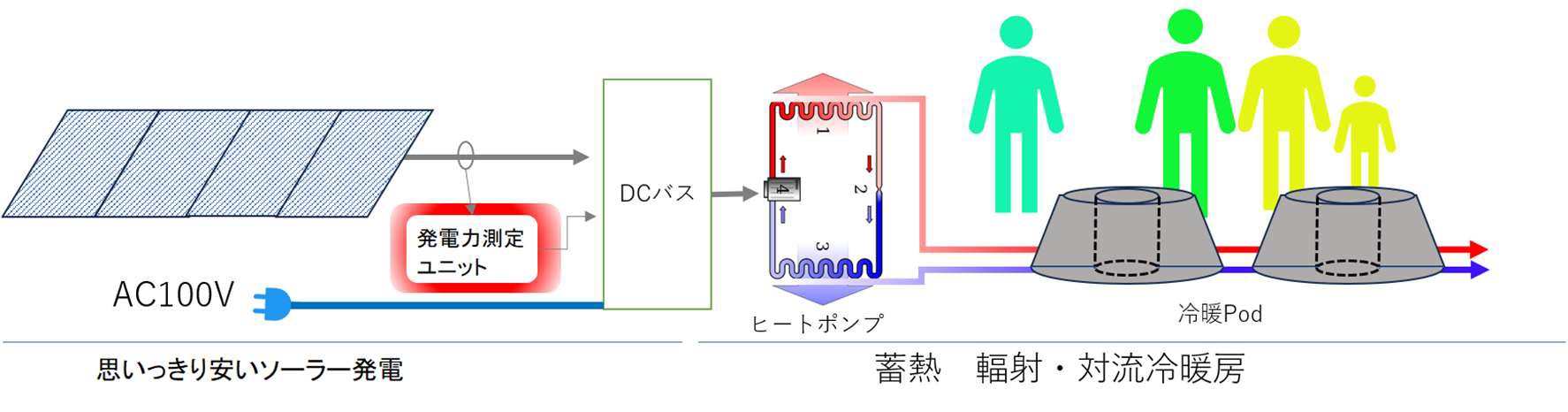
It is cooling and heating that provides comfort to each person gathered in the living room or meeting room. The sensible temperature that feels comfortable differs for each person depending on their physical condition, mood, and activity content at that time. So we want to provide the sensible temperature tailored to each person. For example, wouldn't it be nice if different room temperatures were set for each position in the room and each person could take their favorite position...? That is probably possible. To do that, it is necessary to be able to automatically control the room temperature as desired And a mechanism to maintain a stable temperature gradient in a space not divided by walls is necessary. There are changes in the times and new technologies that make this possible.

【Changes in the Times】 Homes are becoming highly insulated
Homes in Japan, which is more humid and warm than other countries, have been said to "make summer the primary consideration" and have been designed mainly to improve ventilation in summer, but those circumstances are changing. It is for energy saving and prevention of global warming, but recent new construction designs require airtightness and insulation of houses. For advanced heat insulation performance grade 6-7 houses, the insulation standard is roughly a UA value of 0.3W/(m2・K). This means that the heat transmission of the contact area between the inside of the building and the outside world should be 0.3W per unit area and 1℃ internal/external temperature difference. For example, if a partner living together lives in a 25m2 studio apartment, their contact area with the outside world (total area of ceiling, walls, floor) is roughly 100m2. If the internal/external temperature difference in winter is 15℃, the allowable heat transmission is 0.3 × 100 × 15 = 450W. This is equivalent to one small electric stove. The insulation standard for past buildings was a very large UA value of 1.5W/(m2・K), so in the previous studio apartment for two people, a whopping 2kW! of heat transmission was allowed. With this, the heat, cold, and chill of the outside air came directly into the room. For example, in summer, when you return to the room, you cool the room that has become hot with an air conditioner, but still it feels like receiving heat radiation from the ceiling... In winter, you warm the freezing room with powerful heating, but the cold still attacks from the surroundings, so you gather around the stove... That was fun in a Showa-era way, but... As a human characteristic, Sensible Temperature = (Room Temperature + Radiation Temperature of surrounding structures) ÷ 2 There is a law like this. For example, even if the room temperature is cooled rapidly, the sensible temperature does not drop as much as thought until the surrounding structures (ceiling, walls, floor) cool down. Since the building structure has become warm before returning home, the sensible temperature does not drop as much as thought until it cools down → Therefore, the air conditioner feels ineffective → So you continue the strong cooling setting and waste power. Before you know it, it gets too cold. So, shouldn't we leave the air conditioner on? Since the building insulation standard is UA value 1.5W/(m2・K), cold air leaks out, which is very wasteful and electricity bills are not negligible. In the first place, even if you operate the air conditioner with 1kW of rapid cooling power, 2kW leaks from the structure, so it is powerless. Until now, automatic control of room temperature was actually impossible. But... If the building insulation standard becomes UA value 0.3W/(m2・K), the energy leakage becomes small, so you can automatically control room temperature as desired with small power. Furthermore, since you can leave the air conditioning on, you can get a comfortable sensible temperature from the moment you return home.
【New Technology】 Radiant Cooling/Heating Technology
We want to provide different sensible temperatures to two people chatting in one room. For that, we use radiant cooling/heating technology. I mentioned earlier that Human Sensible Temperature = (Room Temperature + Radiation Temperature of structure) ÷ 2. Of these, room temperature is the temperature of the air circulating in the room, so it seems difficult to control it separately for each person. (Electric fans allow individual cooling with forced airflow, but it is only an emergency measure for hot conditions) Then what about the radiation temperature of the structure? The two are placed in the same room temperature, but they can take different positions regarding the distance from the structure. In other words, if you are close to a cooled wall, the sensible radiation temperature will be lower, and if you are far, it will be higher. So if you control the radiation temperature of the wall appropriately, you can maintain a stable temperature gradient. Or, if you install multiple cooling/heating radiant panels and set each to your favorite radiation temperature, you can provide different "personal sensible temperatures" even within one room. I have exemplified cooling in summer so far, but this is a theory that can be applied directly to heating in winter by swapping cooling ↔ heating. These were the changes in the times and new technologies that make "Comfortable Cooling/Heating for Everyone" possible. Now, the basis of "Comfortable Cooling/Heating for Everyone" is fine-tuning of air conditioners and radiant cooling/heating technology, but controlling the temperature and position requires more ingenuity than ever before. I will summarize the ingenuity as follows.
【Issues this technology attempts to solve】
Since the cooling/heating environment of shared spaces for multiple people, such as meeting rooms in share houses and living rooms at home, is uniquely determined by air conditioners, personal discomfort occurs.
【Means to solve the issues】
Strengthen insulation of shared spaces and operate air conditioners constantly to control room temperature Install multiple radiant panels in the shared space and set different wall temperatures for each area Finely adjust the set temperature of air conditioners and radiant panels with a small amount of heat in consideration of outside temperature, room temperature, and each person's condition and wishes
【Effects】
Obtain a quiet and calm indoor environment because room temperature adjustment is performed without turning the air conditioning on and off Everyone staying in the shared space can obtain an appropriate sensible temperature and feel comfort Long-time interaction becomes possible overcoming age differences, physical condition differences, or cultural differences
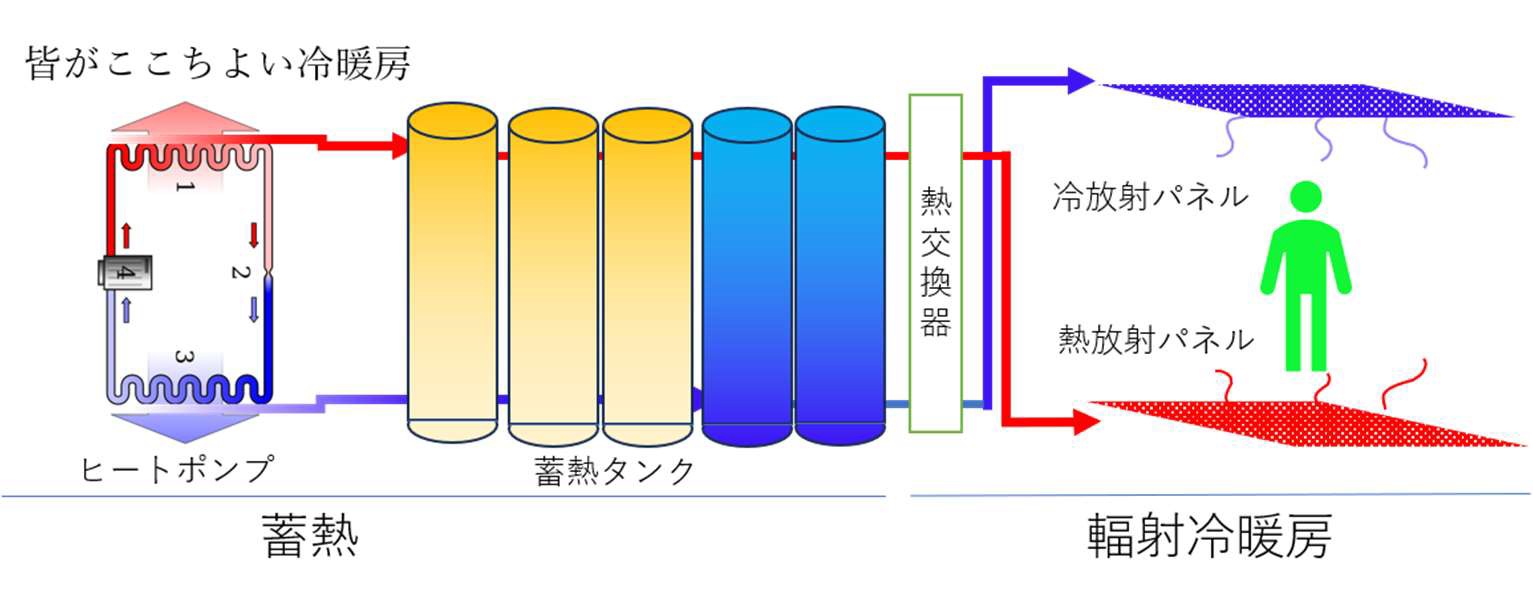
Also, control technology for heat storage tanks requires ingenuity. It is as follows.
【Issues this technology attempts to solve】
Since human sensitivity to the temperature of radiant panels is delicate, it is necessary to adjust the temperature finely. Therefore, the supply of hot/cold water must be changed finely, but repeated starting and stopping of the heat pump is not desirable.
【Means to solve the issues】
Store cold and warm heat in multiple heat storage tanks at a ratio according to the season, and supply it to each radiant panel by changing the temperature with flow control to the heat exchanger. Minimize loss at output/return from heat storage tank to maximize tank heat storage amount. Even if the heat medium reaches the minimum temperature, control is performed to reuse it when the environmental temperature drops and exergy increases. Perform control to maximize the utilization rate of multiple tanks.
【Effects】
Radiant panel adjustment can be done finely and at high speed Heat pump life extends, breakdowns decrease Quiet because nighttime heat pump operation and start/stop are reduced Maximization of heat storage tank capacity utilization rate Minimize stress on heat medium circulation system to extend life Self-consumption rate of solar power generation dramatically improves due to heat storage tank
That's it... The idea looks good, but the equipment seems to be very expensive. Also, where to put the heat storage tank? Since the equipment looks complicated, what if it breaks down!? ...Anxiety is endless.
Drastic cost reduction is necessary for the spread of "Comfortable Cooling/Heating for Everyone"
The introduction cost of radiant cooling/heating, which is the basis of "Comfortable Cooling/Heating for Everyone", is said to be 130,000 yen per tsubo. This calculates to about ten times that of currently mainstream air conditioners. Comfortable but expensive...
This is called a trade-off relationship between comfort and introduction cost. The fact that the comfort obtained cannot be clearly explained despite the high introduction cost seems to be hindering the spread of radiant cooling/heating. However, value related to sensibility such as comfort is difficult to quantify, and its true value has to wait to be proven by experience and track record of introduction. Compared to that, cost down is an effort that can be done immediately. Cost down is to reduce the following various costs/damages and accompanying anxieties. Equipment introduction cost Operation cost (including electricity bill) Maintenance cost Anxiety of failure, purchase cost of substitute machine Disposal cost To pursue cost down... First, is it the electricity bill? "Comfortable Cooling/Heating for Everyone" is basically 24-hour continuous operation. However, leaving the electricity on is against the virtue of frugality, and soaring electricity bills are also a concern. So, what if we operate the air conditioner with electricity from solar power generation? But the sun is sunny or cloudy, and it can't be used at night in the first place. So how about the idea of making cold/hot water with electricity from solar power generation, storing it in a heat storage tank, and using it for the air conditioner as needed? With this mechanism, a self-consumption rate of about 80% for solar power generation seems likely, so on sunny days, almost all electricity for the air conditioner can be covered. Only on cloudy or rainy days, solar energy is insufficient, so you can use electricity from the power company. With this, 24-hour operation of the air conditioner seems forgivable. Regarding leaving the air conditioner on, conversely, it can be said that because the air conditioner is left on, the electricity for cooling and heating can be covered only by small solar power generation. If you use the air conditioner by turning it on and off, the instantaneous power (rapid cooling power) of the air conditioner is required, so the scale of the solar power generation equipment to cover it becomes double or triple, and the introduction cost and installation area become too large. Furthermore, if "Extremely Low-Cost Solar Power" is adopted, a large cost reduction (reduction of introduction cost + operation cost + maintenance cost, etc.) can be achieved.
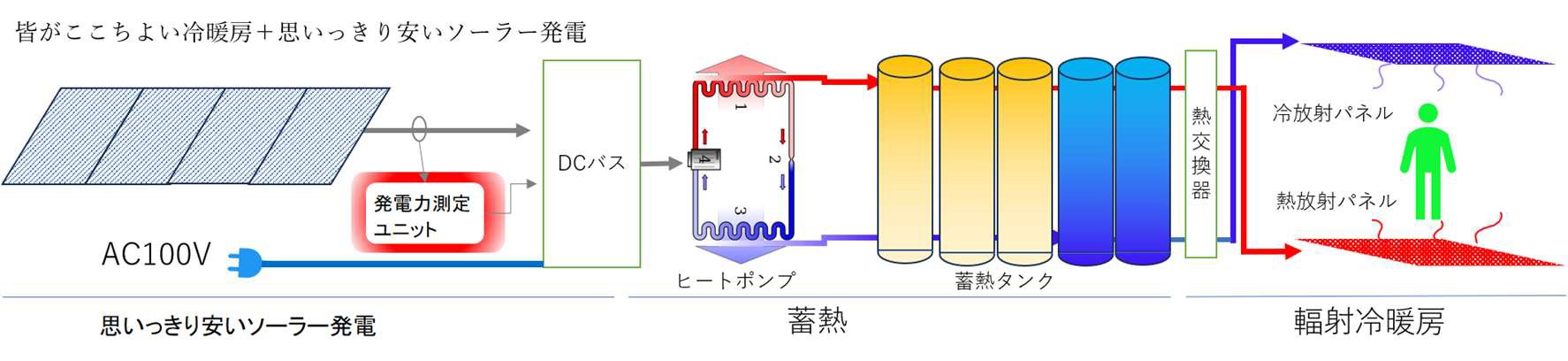
Next As mentioned above, the heat storage tank is an essential function for "Comfortable Cooling/Heating for Everyone" and is indispensable for compromising the time lag between solar power generation and heat utilization timing. But The heat storage tank seems very expensive depending on performance and durability! We will target this for technological innovation and verify feasibility by reviewing purpose, value, performance, and cost. However, the review is not done solely for the heat storage tank but in the grouping of (heat storage + heat exchange + air conditioner + radiation). For example... By confining everything from the heat storage tank and heat exchange to the air conditioner and radiation into one component and installing it in the living room subject to cooling/heating, the heat storage tank seems to require only a simple heat insulation structure. Also, if the cold/warm air of the air conditioner function is transported to the ceiling by a circulator, the temperature of the ceiling can be controlled. In other words, the same effect as installing a radiant panel on the ceiling can be expected,the same goes for the floor and wall. Above all, making it one component seems to reduce the total introduction and maintenance costs. In addition, a size and placement that does not get in the way even if placed in the living room, and an interior-like design are also necessary. Is it an image like this illustration?